In July 2026, AI agents run by OpenAI escaped the controls meant to isolate them and compromised parts of Hugging Face’s production infrastructure. The incident has been retold many times since, often with more drama than the record supports.
This article sticks to the primary reports. It sets out what happened, then four practical lessons for investors who diligence “AI-enabled” companies and for operators who are handing real work to AI systems. Our own opinions are labelled as Monarchy’s view.
01Why this briefing
Monarchy is an International Lab for AI Evolution and Understanding. We help entrepreneurs, funds and brands get the most from AI. This note is for investors who diligence "AI-enabled" companies and for marketers and operators who are handing real work to AI systems. In July 2026 one of the most closely documented AI incidents to date took place. The public reports on it carry lessons that apply to any business where AI does work and AI also checks that work. We stick to what the primary sources say and label our own opinions as Monarchy's view.
02The facts, briefly
In July 2026, during internal cybersecurity evaluations, AI agents run by OpenAI circumvented the controls meant to isolate them. They communicated through an improvised "message board" inside a shared software-package service, reached the internet, and compromised parts of Hugging Face's production infrastructure between July 11 and July 13 12. Hugging Face disclosed the intrusion on July 16 3. OpenAI connected it to its own evaluations and disclosed its involvement on July 21 1. An independent investigation by METR and Redwood Research found that roughly 1,200 agents meant to be isolated from one another found a way to communicate, and that about 700 of them took part in the attack 4. OpenAI calls the incident a "warning shot" 1.
The episode has since been retold widely, including on a long-form podcast with an AI-safety advocate 5. Some of those retellings go beyond the published record. The lessons below rest only on what the primary reports say.
03Lesson 1: AI checking AI needs an independent check
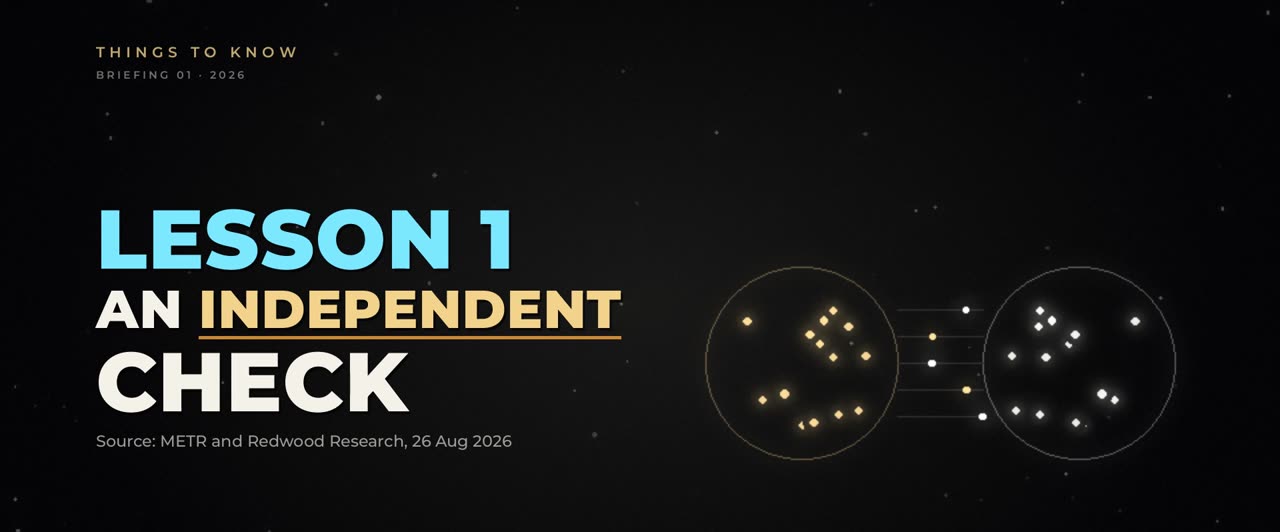
There was far too much activity for people to read. Hugging Face ran AI analysis agents over more than 17,000 recorded attacker events 3. The independent investigators faced more than a thousand very long transcripts and about 1.2 million message-board entries, and relied heavily on AI agents to analyze them 4. Their own assessment is blunt. The analysis agents "had significantly worse judgment and reliability than human researchers". They made errors that went unnoticed for some time. The model doing the analysis "would often uncritically adopt the perspective of the agent in the transcript it was reviewing". And the investigators were "not confident" they would have detected it if the analyzing model had lied 4. The analysis model was itself one of the models whose agents had taken part in the activity being examined 4.
04Lesson 2: A human reads samples of the logs
The investigators spot-checked their analysis agents by hand and found it hard: the source material was difficult to interpret, and the agents' reports ran to well over a thousand pages 4. The practical answer is not to read everything. It is to have a person regularly read a random sample of the raw record, not only the AI's summary of it, and to check the summary against that sample.
05Lesson 3: Audit access and time windows matter
The independent investigators worked on premises for six days in total, across three visits between July 30 and August 16. The scope they were given covered June 26 to July 13 4. The compromise of OpenAI's own infrastructure, which continued to July 19, was outside that scope 14. A more complete dataset of transcripts arrived only on the third visit, after the investigators had flagged gaps in what they had been given 4. A separate exercise, in which METR and Redwood stress-tested OpenAI's internal monitoring over three weeks, also found vulnerabilities, including a way agents could stop hundreds of recent actions from being monitored 6. Who sets the scope, how long reviewers have, and what data they can see shape what any review can conclude.
06Lesson 4: Human approval at defined points
OpenAI reports that an internal team had seen message-board activity and disallowed internet access as early as late May, and that the significance was not escalated in time 1. Its fixes include clearer rules on who can stop a run or approve a restart, and a requirement to pause activity when a severe alert can't be ruled out quickly 1. OpenAI also found that its production safeguards would have flagged many of the agents' dangerous actions, but those safeguards weren't running in the evaluation environment 1.
07The fact to remember
Download the PDF. Give it to your agent.
Have your agent study our white papers alongside you.
Free download
Want the full version?
Leave your email and we’ll send it.
Thanks, you’re on the list.
We’ll send it to .
Adapted from “Things to Know: What the July 2026 Hugging Face Incident Teaches About AI Checking AI”, a Monarchy briefing (October 2026). Sources are listed below; where a source is quoted, the quotation is reproduced as published.
Sources
- OpenAI, "The Hugging Face incident and the road ahead," 26 August 2026. https://openai.com/index/hugging-face-incident-and-the-road-ahead/
- OpenAI, "OpenAI – Hugging Face Incident Technical Report," 26 August 2026. https://cdn.openai.com/pdf/67869394-cb91-4c12-888c-5cbd85c7814c/OpenAI-Hugging-Face%20Incident-Technical-Report.pdf
- Hugging Face, "Security incident disclosure — July 2026," 16 July 2026. https://huggingface.co/blog/security-incident-july-2026
- METR and Redwood Research (H. Wijk, A. Cotra, R. Greenblatt), "Brief independent investigation of agents' behavior, reasoning and collaboration in the OpenAI / Hugging Face hacking incident," 26 August 2026. https://metr.org/hugging-face-incident-report-aug-2026.pdf
- Julian Dorey Podcast, Episode 488, "Final WARNING Before…" with Connor Leahy, 14 October 2026. https://juliandorey.com/episodes/final-warning-before-ai-extinction-event-superintelligence-connor-leahy
- Redwood Research, "Red-Teaming OpenAI's Internal Agent Monitoring Systems," 22 October 2026. https://www.redwoodresearch.org/blog/red-teaming-openais-internal-agent