Every wave of marketing, from the first banner ads to algorithmic performance advertising, ran on the same principle: capture human attention, earn the click, convert. That principle no longer holds on its own.
This article sets out the central argument of the Monarchy white paper “You are not talking to a human”: what has changed, why AI is unlike any technology before it, and five sourced findings that show the shift already under way. Opinions are labelled as Andrea d’Agostini’s view.
01What this white paper answers
- Which foundational rules of marketing have permanently broken—and what replaces them?
- How is AI reshaping how companies are built, operated, and grown—not as a faster tool, but as the new buyer and operator?
- When AI agents filter the market before a human ever sees your brand, how does a business get chosen?
- Where does real economic value migrate when content and execution drop to near-zero cost?
- Why are traditional marketing agencies and billable-hour models becoming obsolete—and why must companies own their growth assets instead?
- How should investors and operators evaluate whether a company will compound or decay over the next 12 to 36 months?

02Thesis
For thirty years, marketing evolved through a continuous succession of channels: from the first display banners in 1994 and early web portals, to email marketing, to search engines and pay-per-click (PPC), to social media feeds, influencer and creator marketing, and algorithmic performance advertising. Across every wave, the medium changed, but the governing principle stayed the same: capture human attention, earn the click, and convert on properties you control. Today, we have entered the Agentic Era, an environment governed by principles fundamentally different from every stage that preceded it. Because the governing principles have changed, the success criteria that produced winners in every prior era no longer produce success today.
Our thesis is that the concept of economic value itself has shifted. Strategy in the agentic era is not an incremental optimization of what came before; it is a completely different set of operating criteria. These criteria remain largely invisible to most of the market for one reason: the velocity of technological change now far exceeds the human rate of adaptation, making a structural shift of epic proportions hard to see in real time. Value is moving to three things a business can own: verifiable truth about what it offers, earned preference (brand, trust and community), and proprietary know-how plus the operating businesses it is applied to.
Beneath the surface, the foundations of the attention economy are actively eroding. That erosion is not yet visible in aggregate advertising spend only because of a recognition and budgeting lag: operators keep pouring more budget into legacy channels assuming higher spend will restore past returns, even as unit performance declines across most categories. Most companies are still trying to build a more optimized DVD rental business, optimizing for unit sales and rental yields, at the exact moment when Netflix has already become the dominant reality. When the medium and the buyer change at the root, there is nothing left to optimize. The only viable move is to evolve.
03Why AI is different: AI is adopting us
Every technology before AI was an extension of human capability: the tractor extended the body; the calculator, personal computer, software and mobile extended memory and reach. All of them were passive instruments waiting for a human operator to adopt them, learn their interface and direct every step.
04Five findings
The web’s audience has changed.
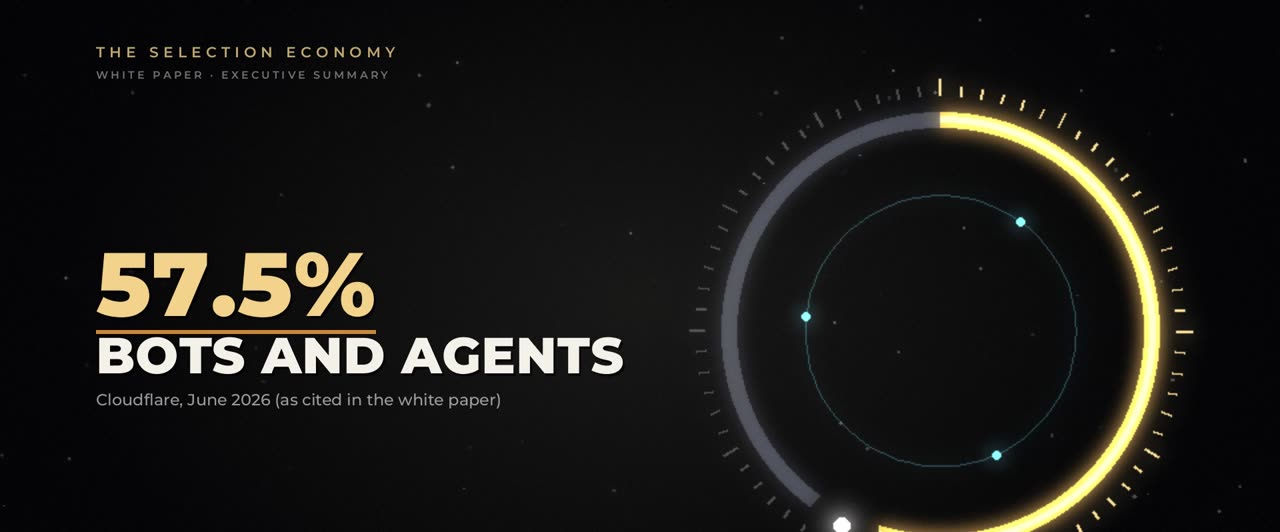
Cloudflare reported in June 2026 that bots and agents generated 57.5% of HTTP requests on its network, against 42.5% from humans1. Imperva had already found automated traffic at 51% of all web traffic in its 2025 report2.
The click is disappearing.
In January to April 2026, 68.01% of US Google searches ended without a click, up from 60.45% in 2024, according to SparkToro and Similarweb3.
The revenue lines have not shown it yet.
Google’s advertising revenue grew from $264.6 billion in 2024 to $294.7 billion in 20254. A lag between a shift in behavior and a shift in reported revenue is normal. It is also where mispricing lives.
AI adoption is broad, but financial impact is narrow.
McKinsey’s 2026 survey found nearly nine in ten organizations use AI regularly in at least one function, yet only 37% attribute any EBIT impact to it, and only about 6% qualify as high performers5. About one in five say AI operating costs already constrain their use5.
Sameness is a measured risk.
In a controlled study published in Science Advances, writers given AI ideas produced stories rated more creative, but the stories were more similar to each other6. When every competitor uses the same tools, “better” stops being a differentiator.
Download the PDF. Give it to your agent.
Have your agent study our white papers alongside you.
Free download
Want the full version?
Leave your email and we’ll send it.
Thanks, you’re on the list.
We’ll send it to .
Adapted from the Monarchy white paper “You are not talking to a human” (2026) by Andrea d’Agostini. Sources are listed below. Statements marked as views are opinions.
Sources
- Tom’s Hardware, “‘Bots have now passed human traffic online,’ Cloudflare boss laments,” 4 June 2026 (reporting Cloudflare Radar data: 57.5% bot vs 42.5% human HTTP requests). https://www.tomshardware.com/tech-industry/artificial-intelligence/bots-have-now-passed-human-traffic-online-cloudflare-boss-laments-says-agentic-traffic-wasnt-expected-to-eclipse-real-people-until-next-year . Underlying data: Cloudflare Radar, https://radar.cloudflare.com/traffic#bot-vs-human
- Imperva, 2025 Bad Bot Report (automated traffic 51% of all web traffic; bad bots 37%). https://www.imperva.com/resources/resource-library/reports/2025-bad-bot-report/
- SparkToro (Rand Fishkin) with Similarweb data, “In 2026, Less than One Third of Google Searches Still Send a Click,” 9 June 2026 (68.01% zero-click Jan-Apr 2026, US; 60.45% in 2024; AI Overviews on 20%+ of searches). https://sparktoro.com/blog/in-2026-less-than-one-third-of-google-searches-still-send-a-click/
- Alphabet Inc., Q4 and Fiscal Year 2025 results, 4 February 2026, and 2025 Form 10-K revenue disaggregation (Google advertising $264.590B in 2024, $294.691B in 2025; Search & other $224.532B in 2025). https://www.sec.gov/Archives/edgar/data/1652044/000165204426000012/googexhibit991q42025.htm and https://www.sec.gov/Archives/edgar/data/1652044/000165204426000018/R12.htm
- McKinsey & Company, “The state of AI in 2026: On the road to ROI,” 25 August 2026 (survey of 1,719 participants, fielded 4 May-8 June 2026). https://www.mckinsey.com/capabilities/quantumblack/our-insights/the-state-of-ai
- Doshi, A. R. and Hauser, O. P., “Generative AI enhances individual creativity but reduces the collective diversity of novel content,” Science Advances 10, eadn5290 (2024). https://www.science.org/doi/10.1126/sciadv.adn5290