For decades, marketing rested on four assumptions: there is a human on the other side, exposure equals attention, behaviour equals intent, and persuasion equals strategy. In 2026 all four broke at the same time.
This article walks through the evidence: an audience that is no longer mostly human, a click that is disappearing, production that has become a commodity, and revenue lines that have not shown the shift yet. Each figure is sourced, the caveats are kept, and opinions are labelled as Andrea d’Agostini’s view.
01The Shift: Four Things Broke at Once
Marketing has rested on four foundational assumptions for decades. In 2026, all four have broken at once:
- 01There is a human on the other side.
- 02Exposure equals attention.
- 03Behavior equals intent.
- 04Persuasion equals strategy.
The audience is no longer mostly human
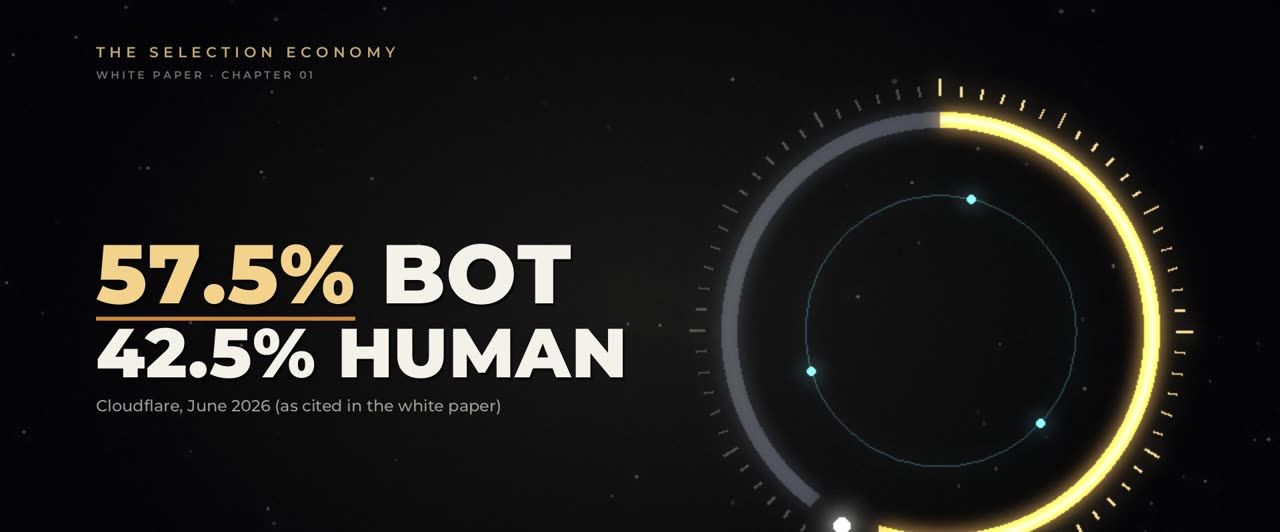
On 3 June 2026, Cloudflare’s CEO Matthew Prince said bots had passed human traffic online “for the first time in the Internet’s history.” Cloudflare’s data at the time showed a split of 57.5% bot to 42.5% human HTTP requests1. Cloudflare attributes much of the growth to AI agents that read product pages, check prices, compare options and complete multi-step tasks on behalf of people1.
Imperva’s 2025 Bad Bot Report reached a similar conclusion from a different data set: automated traffic was 51% of all web traffic, and bad bots alone were 37%2.
The click is disappearing
SparkToro and Similarweb found that 68.01% of US Google searches in January to April 2026 ended without a click, up from 60.45% in 2024, and from about 45% roughly a decade ago3. The same study notes that AI Overviews now appear on more than 20% of searches and, when present, reduce click-through rate by nearly 60%3. Gartner predicted in February 2024 that traditional search engine volume would drop 25% by 2026 as AI chatbots and virtual agents substitute for queries4. That is a forecast, not a measurement, but it points in the same direction.
Panels differ by year, as SparkToro itself cautions. Source: SparkToro & Similarweb 3
The buyer still has intent. The answer simply arrives before anyone reaches a website.

Commodity production is only the symptom: the collapse of experience and competence
The fact that production has become a commodity (Stanford’s AI Index 2025 reports inference costs at the GPT-3.5 level fell more than 280-fold in two years5, and 32% of organizations in McKinsey’s 2026 survey already build software in-house with agentic tools instead of buying it6) is only a symptom, not the real problem. Beneath the cost-and-speed story, technological velocity is outrunning human capacity to adapt, creating two structural phenomena. First, organizations increasingly assume they no longer need lived experience to make decisions, hiring ever-younger, less-experienced staff across markets that carry a deep, multi-generational history. When customer understanding is built by asking an AI rather than speaking directly with real people, companies create the illusion of market knowledge while drifting from ground truth. In Edward Lorenz’s classic numerical weather prediction experiment at MIT7, two computer runs started from the same underlying data substrate; left to run without continuous inspection and correction against real-world physical observations, the uninspected model rapidly diverged until it predicted the exact opposite weather. Subsequent research in Nature confirmed the same mechanism in AI: models fed synthetic outputs without fresh real-world human data suffer model collapse8.
Second, the deeper crisis is not that production has become fast and easy, but that real competence is disappearing. Because anyone can now generate anything, completely incompetent operators gain a short-term floor and improve slightly9, while the entire industry converges on the exact same mental level of competence and creation. Every ad looks the same, every website looks the same, and every piece of copy reads the same, fueling an exponential mania to push out more communication faster, where each piece means progressively less.
Why the revenue lines have not shown it yet
If attention is eroding, why is the largest attention business still growing? Alphabet reported Google advertising revenue of $294.7 billion for 2025, up from $264.6 billion in 2024, with Google Search & other at $224.5 billion10. SparkToro’s own reading is that Google’s zero-click changes have so far boosted ad revenue and investor confidence3.
Growth on the surface, erosion underneath: read with Chart B. Source: Alphabet Inc., FY2025 results and 2025 Form 10-K 10
That is not a contradiction. A platform can capture more value while the businesses that pay it receive less traffic in return. The question for an investor in those businesses is not whether the platform is healthy. It is whether the business’s customer acquisition still works when the buyer’s agent does the shortlisting.
Download the PDF. Give it to your agent.
Have your agent study our white papers alongside you.
Free download
Want the full version?
Leave your email and we’ll send it.
Thanks, you’re on the list.
We’ll send it to .
Adapted from the Monarchy white paper “You are not talking to a human” (2026) by Andrea d’Agostini. Sources are listed below. Statements marked as views are opinions.
Sources
- Tom’s Hardware, “‘Bots have now passed human traffic online,’ Cloudflare boss laments,” 4 June 2026 (reporting Cloudflare Radar data: 57.5% bot vs 42.5% human HTTP requests). https://www.tomshardware.com/tech-industry/artificial-intelligence/bots-have-now-passed-human-traffic-online-cloudflare-boss-laments-says-agentic-traffic-wasnt-expected-to-eclipse-real-people-until-next-year . Underlying data: Cloudflare Radar, https://radar.cloudflare.com/traffic#bot-vs-human
- Imperva, 2025 Bad Bot Report (automated traffic 51% of all web traffic; bad bots 37%). https://www.imperva.com/resources/resource-library/reports/2025-bad-bot-report/
- SparkToro (Rand Fishkin) with Similarweb data, “In 2026, Less than One Third of Google Searches Still Send a Click,” 9 June 2026 (68.01% zero-click Jan-Apr 2026, US; 60.45% in 2024; AI Overviews on 20%+ of searches). https://sparktoro.com/blog/in-2026-less-than-one-third-of-google-searches-still-send-a-click/
- Gartner, “Gartner Predicts Search Engine Volume Will Drop 25% by 2026, Due to AI Chatbots and Other Virtual Agents,” press release, 19 February 2024 (a forecast). https://www.gartner.com/en/newsroom/press-releases/2024-02-19-gartner-predicts-search-engine-volume-will-drop-25-percent-by-2026-due-to-ai-chatbots-and-other-virtual-agents
- Stanford HAI, AI Index Report 2025 (inference cost at GPT-3.5 level fell over 280-fold, Nov 2022 to Oct 2024). https://hai.stanford.edu/ai-index/2025-ai-index-report
- McKinsey & Company, “The state of AI in 2026: On the road to ROI,” 25 August 2026 (survey of 1,719 participants, fielded 4 May-8 June 2026). https://www.mckinsey.com/capabilities/quantumblack/our-insights/the-state-of-ai
- Lorenz, E. N., “Deterministic Nonperiodic Flow,” Journal of the Atmospheric Sciences 20(2), 130-141 (1963). https://doi.org/10.1175/1520-0469(1963)020<0130:DNF>2.0.CO;2
- Shumailov, I. et al., “AI models collapse when trained on recursively generated data,” Nature (2024). https://www.nature.com/articles/s41586-024-07566-y
- Doshi, A. R. and Hauser, O. P., “Generative AI enhances individual creativity but reduces the collective diversity of novel content,” Science Advances 10, eadn5290 (2024). https://www.science.org/doi/10.1126/sciadv.adn5290
- Alphabet Inc., Q4 and Fiscal Year 2025 results, 4 February 2026, and 2025 Form 10-K revenue disaggregation (Google advertising $264.590B in 2024, $294.691B in 2025; Search & other $224.532B in 2025). https://www.sec.gov/Archives/edgar/data/1652044/000165204426000012/googexhibit991q42025.htm and https://www.sec.gov/Archives/edgar/data/1652044/000165204426000018/R12.htm