“AI will cut our costs” is one of the most repeated sentences in boardrooms. Sometimes it is true: there are well-documented cases of AI doing work at a scale that changes the numbers.
But the aggregate picture is more sober. This article sets one widely cited success story against the McKinsey survey data, explains why cheaper AI can still mean a bigger bill, and closes with what distinguishes the small group of companies that do capture value. Opinions are labelled as Andrea d’Agostini’s view or Monarchy’s view.
01The Economics of AI: A Cost to Manage, Not a Saving to Assume
“AI will cut our costs” is one of the most repeated sentences in boardrooms. It deserves hard questions.
The promise is real. In February 2024, Klarna reported that its AI assistant handled 2.3 million conversations in its first month, two-thirds of its customer service chats, doing the equivalent work of 700 full-time agents, with an estimated $40 million profit improvement for 20241. Unit costs of AI have fallen sharply2.
Source: Klarna, February 2024 1
But the aggregate picture is more sober. In McKinsey’s 2026 State of AI survey3:
- Nearly nine in ten respondents report regular AI use in at least one business function.
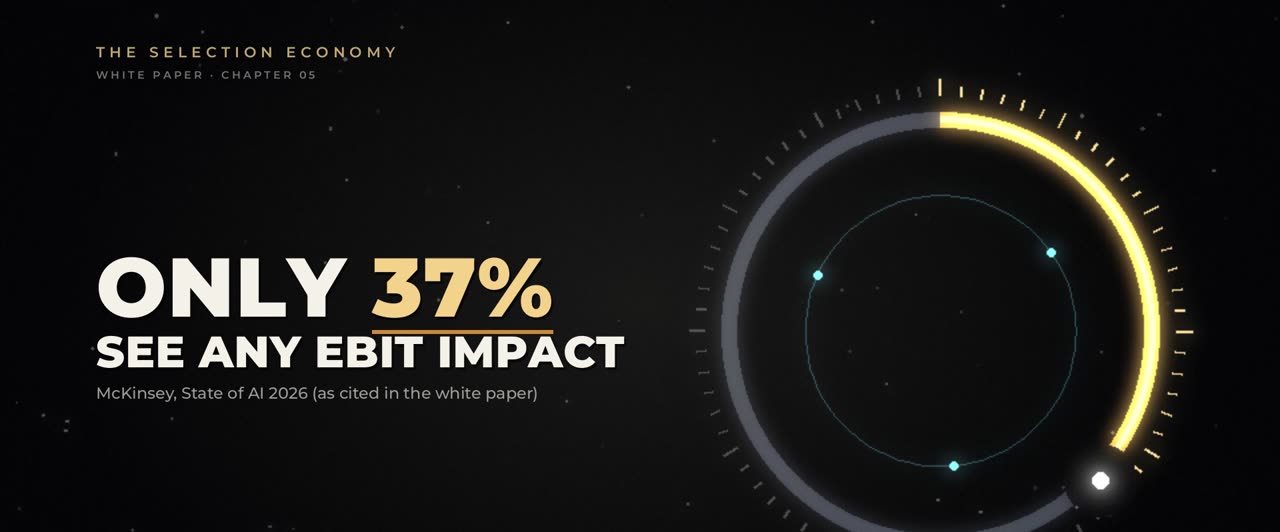
- Only 37% attribute any EBIT impact to AI, essentially unchanged from the prior year.
- About 6% qualify as “AI high performers” (at least 5% of EBIT attributed to AI and “significant” value).
- About 20% say AI operating costs, including token costs, constrain their use.
- 80% of respondents say AI has improved their individual productivity, a gain that has not yet translated into broad financial impact.
“Nearly 9 in 10” is drawn at 90% for illustration only. Source: McKinsey & Company, 2026 3
Why the gap?

What separates the few who capture value
McKinsey’s high performers are distinguished less by their tools than by their intent and discipline. They pursue growth and innovation alongside efficiency. Nearly three-quarters report fundamentally redesigning workflows because of AI, against one-quarter of other respondents. They are twice as likely to have senior leaders visibly committed and defined processes to measure impact3.
Download the PDF. Give it to your agent.
Have your agent study our white papers alongside you.
Free download
Want the full version?
Leave your email and we’ll send it.
Thanks, you’re on the list.
We’ll send it to .
Adapted from the Monarchy white paper “You are not talking to a human” (2026) by Andrea d’Agostini. Sources are listed below. Statements marked as views are opinions.
Sources
- Klarna, “Klarna AI assistant handles two-thirds of customer service chats in its first month,” press release, 27 February 2024. https://www.klarna.com/international/press/klarna-ai-assistant-handles-two-thirds-of-customer-service-chats-in-its-first-month/
- Stanford HAI, AI Index Report 2025 (inference cost at GPT-3.5 level fell over 280-fold, Nov 2022 to Oct 2024). https://hai.stanford.edu/ai-index/2025-ai-index-report
- McKinsey & Company, “The state of AI in 2026: On the road to ROI,” 25 August 2026 (survey of 1,719 participants, fielded 4 May-8 June 2026). https://www.mckinsey.com/capabilities/quantumblack/our-insights/the-state-of-ai
- Moffatt v. Air Canada, 2024 BCCRT 149 (Civil Resolution Tribunal of British Columbia). https://www.canlii.org/en/bc/bccrt/doc/2024/2024bccrt149/2024bccrt149.html