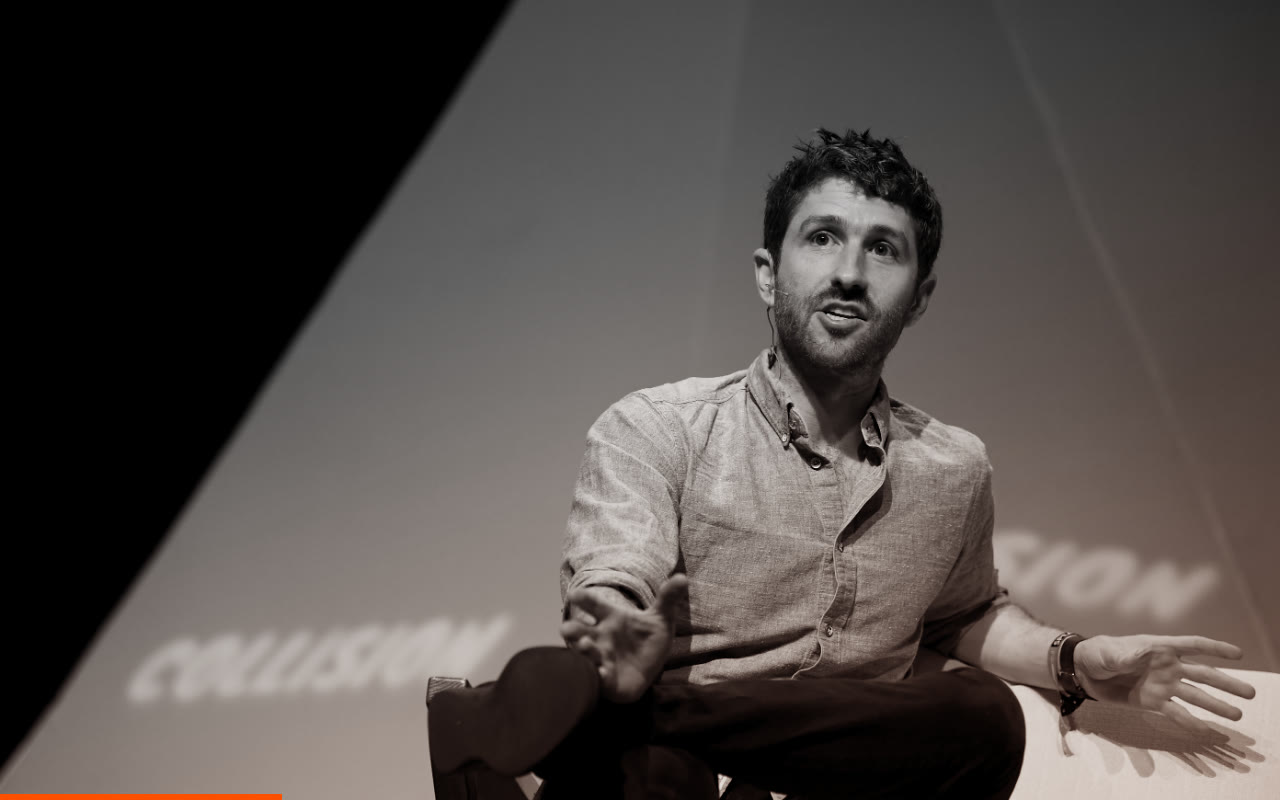
A short clip of Tristan Harris, co-founder of the Center for Humane Technology, has been circulating on social media. In it he asks what happens when most of the US economy comes from AI and data centers instead of people, and he calls the result “a devaluing of humans” 2.
We watched the full session. It is longer, more careful and more useful than the clip. The part that travelled is not about machines turning on us. It is about money, and about who the money stops investing in.
01What Harris actually said in the full session
Harris spoke on 5 May 2026 at the Milken Institute Global Conference in Los Angeles, on a panel titled “AI and Humanity: Evolution or Revolution?”, moderated by Erik Schatzker of Bloomberg, with Suzanne DiBianca of Salesforce, Amy Webb of Future Today Strategy Group and will.i.am of FYI.AI 1. The full session is on the Milken Institute’s official YouTube channel 2.
Midway through, he made his central claim: “I’m going to make a strong claim that we are heading to an anti-human future when it comes to humans having a value, humans being valued...” 2.
His argument is about incentives, not intent. “Everything can be predicted by the arms race dynamic.” 2 On what pays back the hundreds of billions invested in frontier AI: “What makes back that investment is the race to replace human work...” 2. Then the competitive logic: “And the companies and businesses that adopt AI faster and swap out their workforce, they’re going to outcompete the companies that don’t do that... So it’s an arms race all the way down.” 2
He does not claim the idea as his own. He credits the “intelligence curse” to the writers Luke Drago and Rudolf Laine, and explains that it is “modeled after something in economics called the resource curse” 2. Drago and Laine wrote in April 2025 that with AGI, powerful actors would lose their incentive to invest in regular people, the way resource-rich states neglect their citizens when their wealth comes from natural resources rather than from taxing human labor 5.
Then he takes the logic to the state. “What happens when 60 to 70% of the US GDP comes from AI and from data centers and not from people?” 2 That figure is his own projection. He cites no source for it, and it does not appear in Drago and Laine’s essay 5. In measured data, AI-related investment was about 4% of US GDP in 2025 6.
The scenario he builds on it is the uncomfortable part: “And if I’m a government, I’ve got tax revenue, do I have an incentive to put that money that I’m gaining into education and childcare and healthcare and the development of my people? Well, I don’t get a return on that anymore.” And: “I have a strong incentive to put that into data centers.” 2 Harris describes an incentive here, not a budget decision any government has made.
This is a devaluing of humans, not because I’m saying anybody’s evil or wants that, but there’s the temptation when AI is doing all the work and all the labor...
Tristan Harris, Milken Institute Global Conference, 5 May 2026 2
His conclusion: “...you’re going to get an AI-first world and we don’t have a plan to value the humans in it.” 2
Along the way, he paraphrased Sam Altman as saying it takes energy “to grow a human over 20 years” 2. Altman’s actual words came at Express Adda, hosted by The Indian Express on 20 February 2026 on the sidelines of the India AI Impact Summit: “But it also takes a lot of energy to train a human. It takes like 20 years of life and all of the food you eat during that time before you get smart.” 3 Altman was comparing the energy ChatGPT uses to answer one question with the energy a human uses, and he called concern about AI’s total energy use “fair” 34.
Harris also offered a way out: “And there is a way out of it... we need to turn the intelligence curse into intelligence dividend, like what Norway did with the sovereign wealth fund. There’s a few counter examples, but you have to do things early and right...” 2 Later he added: “And it doesn’t have to be this way. We can have a controllable AI future that is actually pro-human...” 2
02The data
Projection versus reality. AI-related investment is about 4% of US GDP and, once imports are stripped out, accounted for about 20% of US GDP growth in the first nine months of 2025 6. An MRB Partners analysis put the import-adjusted contribution at “about 20%-25% of real GDP growth” over the same three quarters 7. A large share of growth. Not most of the economy.
Capex. Amazon, Google, Meta and Microsoft guided to roughly $735 to 750 billion of capital spending for 2026, according to a tracker that totals their guidance as of July 2026 8. Stargate was announced on 21 January 2025 as “a new company which intends to invest $500 billion over the next four years building new AI infrastructure for OpenAI in the United States” 9. That is private money, not government spending. The money behind the race Harris describes is visible in company budgets.
Labor share. The share of output paid to workers in the US nonfarm business sector was 52.8 percent in the second quarter of 2026, the lowest level ever recorded 10. The Bureau of Labor Statistics does not attribute this to AI, and neither do we. But it measures exactly what Harris worries about: how much of the output goes to people.
03My take: a new era of awakening
04Where human interaction becomes the premium
In a Gartner survey of 5,728 customers, 64% said they would prefer that companies did not use AI in their customer service, and 53% said they would consider switching to a competitor if a company was going to use AI for customer service. Their top concern: it would get harder to reach a person 11.
Klarna, which still calls itself “AI-first”, has said the same thing from the inside 12. In May 2025 its CEO, Sebastian Siemiatkowski, told Bloomberg “it’s so critical that you are clear to your customer that there will be always a human if you want” 12. On what went wrong, he was blunt: “As cost unfortunately seems to have been a too predominant evaluation factor when organizing this, what you end up having is lower quality.” 12
The sentiment is broader than customer service. In a Pew survey of 5,023 US adults in June 2025, 50% said AI will worsen people’s ability to form meaningful relationships, and 5% said it will improve it 13.
This connects to our series “How AI is thinking”, which starts with “AI didn’t panic. It optimized.”: agents optimize what you measure, and economies optimize what pays.
Questions this article answers
Should Ask Questions
SAQ: the questions you should be asking (and nobody is)
- If I removed every human from my customer’s path tomorrow, what would they lose that I am not currently measuring?
- Which part of my business is valuable because a person is in it, and would I know if that stopped being true?
- What am I optimizing for this year, and what does that metric quietly tell my team about people?
- When AI does the work, who in my company still has a reason to be developed, trained and paid more?
An original Monarchy article (October 2026). Sources are listed below; quotations are reproduced as published. Statements marked as views are opinions.
Sources
- Milken Institute, “AI and Humanity: Evolution or Revolution?”, Global Conference 2026 panel page, 5 May 2026. https://milkeninstitute.org/content-hub/event-panels/ai-and-humanity-evolution-or-revolution
- Milken Institute (official YouTube channel), “AI and Humanity: Evolution or Revolution? | Global Conference 2026”, full session video, uploaded 8 May 2026. https://www.youtube.com/watch?v=AZIQ90TUTaM
- The Indian Express, “Sam Altman at Express Adda: Why training a human for 20 years uses more energy than ChatGPT”, Express Adda of 20 February 2026. https://indianexpress.com/article/technology/artificial-intelligence/ai-energy-water-usage-sam-altman-openai-express-adda-10546154/
- CNBC, report on Sam Altman at Express Adda, 23 February 2026. https://www.cnbc.com/2026/02/23/openai-altman-defends-ai-resource-usage-water-concerns-fake-humans-use-energy-summit.html
- Luke Drago and Rudolf Laine, “Defining the Intelligence Curse”, The Intelligence Curse, April 2025. https://intelligence-curse.ai/defining/
- “Artificial Intelligence and the US Economy: An Accounting Perspective on Investment and Production”, arXiv:2601.11196 (working paper), January 2026. https://arxiv.org/html/2601.11196
- CNBC, report on MRB Partners’ analysis of AI and 2025 US GDP growth, 26 January 2026. https://www.cnbc.com/2026/01/26/ai-wasnt-the-biggest-engine-of-us-gdp-growth-in-2025.html
- Charles Fitzgerald, “Follow the CAPEX: Q2 2026 Scoreboard”, Platformonomics, 31 July 2026 (totals from company guidance). https://platformonomics.com/2026/07/follow-the-capex-q2-2026-scoreboard/
- OpenAI, “Announcing The Stargate Project”, 21 January 2025. https://openai.com/index/announcing-the-stargate-project/
- US Bureau of Labor Statistics, The Economics Daily, labor share in the nonfarm business sector, 15 September 2026. https://www.bls.gov/opub/ted/2026/labor-share-at-its-lowest-level-52-8-percent-in-second-quarter-2026.htm
- Gartner, press release on its customer service survey (5,728 customers, December 2023), 9 July 2024. https://www.gartner.com/en/newsroom/press-releases/2024-07-09-gartner-survey-finds-64-percent-of-customers-would-prefer-that-companies-didnt-use-ai-for-customer-service
- Fortune, “Klarna plans to hire humans again, as new landmark survey reveals most AI projects fail to deliver” (quoting Bloomberg), 9 May 2025. https://fortune.com/2025/05/09/klarna-ai-humans-return-on-investment/
- Pew Research Center, “How Americans View AI and Its Impact on Human Abilities, Society”, 17 September 2025. https://www.pewresearch.org/science/2025/09/17/how-americans-view-ai-and-its-impact-on-people-and-society/
Photo: Stephen McCarthy, Collision via Sportsfile / Wikimedia Commons, CC BY 2.0, adapted