Clips of the former Google CEO Eric Schmidt warning that computers “don’t have to listen to us anymore” keep circulating on social media. Most of them are cut together from a single talk he gave in April 2025 at the Special Competitive Studies Project’s AI+ Biotechnology Summit 12. We went back to the full session, checked his words, and set his forecasts against the data available today.
Two things are true at once. Some of Schmidt’s predictions have not come true on schedule. And the shift he describes is already measurable: in code, in electricity, and in who is reading the web. Forecasts are labelled as forecasts; statements marked as views are opinions.
01Who is Eric Schmidt, and what did he actually say?
Schmidt was Google’s chief executive from 2001 to 2011, then executive chairman, first of Google and then of its parent company Alphabet, until 2018, and technical advisor to Alphabet until 2020 3. He chaired the US National Security Commission on Artificial Intelligence, and in 2021 he founded the Special Competitive Studies Project, which he chairs 3. With Henry Kissinger and Craig Mundie he co-wrote Genesis: Artificial Intelligence, Hope, and the Human Spirit (2024) 5.
In the April 2025 session he laid out, step by step, what he described as a consensus among the people building AI 1:
- Within one year: “the vast majority of programmers will be replaced by AI programmers,” and AI would perform like graduate-level mathematicians “at the tippy top of graduate math programs” 1.
- Already under way, by his account: “the evidence and the claims” from research groups such as OpenAI and Anthropic put the share of their research code generated by the computer at “somewhere around 10 or 20%.” He called this recursive self-improvement 1.
- Within three to five years: general intelligence, a system “as smart as the smartest mathematician, physicist, … artist, writer, thinker, politician” 1.
- Within six years: superintelligence, “computers that are smarter than the sum of humans” 1.
I call this, by the way, the San Francisco consensus because everyone who believes this is in San Francisco.
Eric Schmidt, SCSP AI+ Biotechnology Summit, April 2025 1
Then came the line that travels: once the machines are improving themselves, “they’re learning how to plan and they don’t have to listen to us anymore.” 1 His conclusion was not that AI is overhyped. It was the opposite: “That’s why it’s underhyped. People do not understand what happens when you have intelligence at this level which is largely free.” 1
02The one-year forecast, eighteen months later
Schmidt’s first forecast came with a deadline. In April 2025 he said that “in the next one year, the vast majority of programmers will be replaced by AI programmers.” 1 The official US data does not show that. The Bureau of Labor Statistics counted about 110,800 computer programmer jobs in 2025 and projects a 7 percent decline by 2035, in part because companies are expected to use AI to automate repetitive programming tasks 6. For software developers, the broader engineering role, it projects growth of 15.8 percent between 2024 and 2034, or 267,700 jobs 7.
In the same talk, in a passage the viral clips leave out, Schmidt hedged himself. In the history of automation, he said, “the jobs are changed, but more jobs are created than destroyed. In this case, you’d have to convince me that this time is different.” 1
03The code is already being written by machines
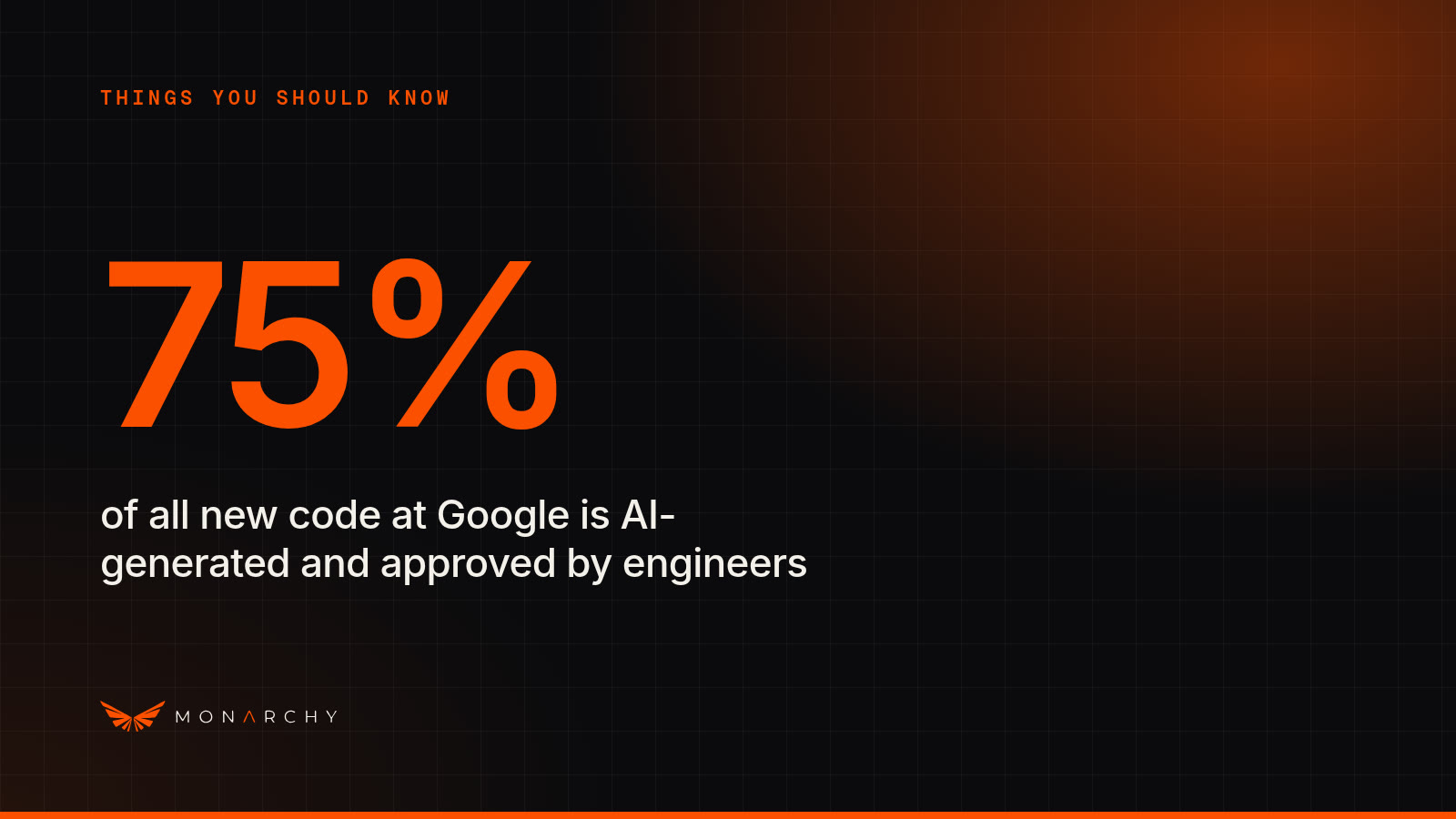
On code, the trend is moving faster than the jobs data. In March 2025, Anthropic’s chief executive Dario Amodei predicted that within three to six months AI would be writing 90 percent of the code 8. In April 2026, Google’s chief executive Sundar Pichai wrote that “75% of all new code at Google is now AI-generated and approved by engineers, up from 50% last fall.” 9
Note the last words: approved by engineers. The code is machine-written; the responsibility is still human. And more output is not automatically faster work. In a randomized study published in July 2025, METR found that experienced open-source developers using early-2025 AI tools took 19 percent longer to complete their tasks, even though they believed the tools had made them about 20 percent faster 10.
04“They don’t have to listen to us anymore”: forecast or fact?
Recursive self-improvement means AI systems helping to build better AI systems. Schmidt’s sequence runs from there to general intelligence in three to five years and to superintelligence within six, “just based on scaling.” 1 These are forecasts, not findings, and Schmidt treats them that way himself. In his essay on the San Francisco consensus he writes: “The fact that such a consensus is widely held does not, of course, make it true.” 4
Here is how the claims sort out:
- Forecast (April 2025): most programmers replaced by AI within a year 1. Not visible in the BLS data 67.
- Forecast (March 2025): AI writing 90 percent of the code within three to six months 8.
- Reported fact (April 2026): 75 percent of new code at Google is AI-generated and approved by engineers 9.
- Measured (July 2025): in one randomized study, experienced developers were 19 percent slower with early-2025 AI tools 10.
- Forecast (April 2025): general intelligence in three to five years and superintelligence within six, according to what Schmidt calls the San Francisco consensus 1.
05The real limit is power
Schmidt was blunt about the constraint: “you have to have an enormous amount of power.” 1 He told the audience he had testified on it the day before; on 9 April 2025 he was a witness at the House Energy and Commerce Committee hearing on AI and energy 111.
The International Energy Agency puts data centre electricity use at around 415 terawatt-hours in 2024, about 1.5 percent of the world’s electricity, and projects it to more than double to around 945 terawatt-hours by 2030, slightly more than Japan’s total electricity consumption today 12. In the United States, data centres account for nearly half of the growth in electricity demand between now and 2030 12.
06Marketing is on borrowed time
Schmidt’s deeper warning was about speed. “This path is not understood in our society. There’s no language for what happens with the arrival of this.” 1 It is happening, he said, faster than “our society, our democracy, our laws” can respond 1.
Marketing is one of the places where the arrival is already visible. On Cloudflare’s network in June 2026, bots and agents generated 57.5% of HTTP requests, against 42.5% from humans 13. Between January and April 2026, 68.01% of US Google searches ended without a click 14. The four pillars marketing stood on are cracking at the same time: a person on the other side, exposure as attention, behaviour as intent, persuasion as strategy.
Schmidt’s own answer to “how do we get ready for it?” was simple: “we start by talking about it.” 1
Questions this article answers
Should Ask Questions
SAQ: the questions you should be asking (and nobody is)
Part of the Monarchy white paper series “You are not talking to a human” by Andrea d’Agostini (October 2026). Sources are listed below; quotations are reproduced as spoken or published. Forecasts are labelled as forecasts; statements marked as views are opinions.
Sources
- Special Competitive Studies Project (SCSP), “Dr. Eric Schmidt,” fireside chat with Jeanne Meserve at SCSP’s AI+ Biotechnology Summit, video published 10 April 2025 (quotes checked against the full session, approx. 10:20-16:30). https://www.youtube.com/watch?v=L5jhEYofpaQ
- SCSP, “Episode 75: Dr. Eric Schmidt on AI, Biotech, and Global Competition” (a conversation from SCSP’s AI+ Biotechnology Summit), 16 April 2025. https://scsp222.substack.com/p/episode-75-dr-eric-schmidt-on-ai
- Eric Schmidt, official biography, “About Eric” (accessed 27 October 2026). https://ericschmidt.com/bio/
- Eric Schmidt, “The San Francisco Consensus,” The Digitalist Papers, Vol. 2: The Economics of Transformative AI, 11 December 2025. https://www.digitalistpapers.com/vol2/schmidt
- Henry A. Kissinger, Eric Schmidt and Craig Mundie, Genesis: Artificial Intelligence, Hope, and the Human Spirit (Little, Brown, 2024). https://www.littlebrown.com/titles/henry-a-kissinger/genesis/9780316581295/
- U.S. Bureau of Labor Statistics, Occupational Outlook Handbook, “Computer Programmers” (2025 jobs; projections 2025-35; last modified 27 August 2026). https://www.bls.gov/ooh/computer-and-information-technology/computer-programmers.htm
- U.S. Bureau of Labor Statistics, The Economics Daily, “Artificial intelligence, information technology, and employment, 2024-34,” 16 July 2026. https://www.bls.gov/opub/ted/2026/artificial-intelligence-information-technology-and-employment-2024-34.htm
- Council on Foreign Relations, “CEO Speaker Series With Dario Amodei of Anthropic,” 10 March 2025 (transcript). https://www.cfr.org/event/ceo-speaker-series-dario-amodei-anthropic
- Sundar Pichai, “Cloud Next ‘26: Momentum and innovation at Google scale,” Google blog, 22 April 2026. https://blog.google/innovation-and-ai/infrastructure-and-cloud/google-cloud/cloud-next-2026-sundar-pichai/
- METR, “Measuring the Impact of Early-2025 AI on Experienced Open-Source Developer Productivity,” 10 July 2025 (randomized controlled trial; arXiv:2507.09089). https://metr.org/blog/2025-07-10-early-2025-ai-experienced-os-dev-study/
- U.S. House Committee on Energy and Commerce, hearing “Converting Energy into Intelligence: the Future of AI Technology, Human Discovery, and American Global Competitiveness,” 9 April 2025 (witness: Dr. Eric Schmidt, Chair, SCSP). http://democrats-energycommerce.house.gov/committee-activity/hearings/hearing-converting-energy-intelligence-future-ai-technology-human-0
- International Energy Agency, Energy and AI, Executive summary, 10 April 2025. https://www.iea.org/reports/energy-and-ai/executive-summary
- Tom’s Hardware, “‘Bots have now passed human traffic online,’ Cloudflare boss laments,” 4 June 2026 (reporting Cloudflare Radar data: 57.5% bot vs 42.5% human HTTP requests). https://www.tomshardware.com/tech-industry/artificial-intelligence/bots-have-now-passed-human-traffic-online-cloudflare-boss-laments-says-agentic-traffic-wasnt-expected-to-eclipse-real-people-until-next-year
- SparkToro (Rand Fishkin) with Similarweb data, “In 2026, Less than One Third of Google Searches Still Send a Click,” 9 June 2026 (68.01% zero-click Jan-Apr 2026, US). https://sparktoro.com/blog/in-2026-less-than-one-third-of-google-searches-still-send-a-click/